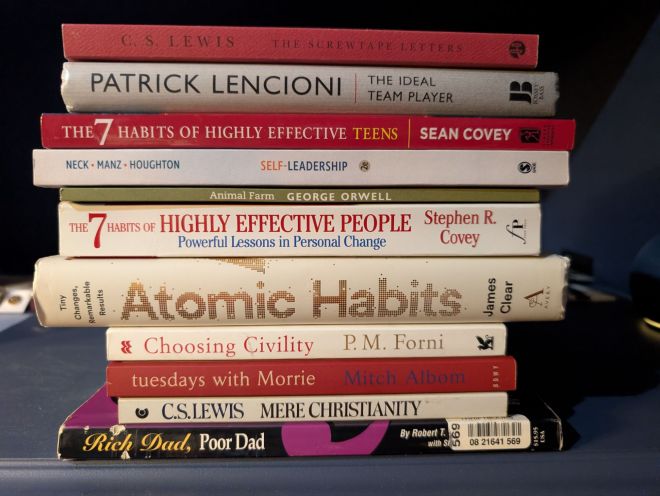
A couple weeks ago, I shared a photo of some of the books I’ve been reading lately, and I mentioned having a list of books I want my kids to read before they leave home. Sadly, that day will come sooner rather than later.
What I didn’t expect was how many people would message me asking:
“What books do you want your kids to read before they graduate high school?”
Honestly, I loved that question.
As a dad, I spend a lot of time thinking about how to prepare my kids for life. Not just academically. Not just athletically. Not just financially.
I’m talking about helping form things like character, wisdom, faith, discipline, leadership, resilience, emotional intelligence, and discernment.
Because eventually, our kids leave home.
And when they do, they won’t just need math formulas, test scores, and resumes. They’ll need wisdom for the decisions nobody grades, character when nobody is watching, and faith when life doesn’t go according to plan.
How it works
That’s part of why I started having my kids read one meaningful book every summer beginning the year they turn 12. As they get older, the expectation will shift into reading more than that until they get through the list. We will talk about it while they read each book, especially some of the heavier reads as they get older. Lastly, my standing offer to them is if they give me a one-page summary after each book, I will give them $20. I can’t think of a better investment in my family’s future.
I’m not doing this to create tiny productivity robots or mini philosophers. I just want to help give them frameworks for life that they most likely won’t get in school. And, for our family, the number one book that guides us is the Bible. I’m not including it in this list because it truly transcends any list I could put together.
Now, I’m going to share the core books on the list along with a brief reason and rationale for why each book has been selected. I definitely have more books in mind for them, but these are the books I want them to complete before they graduate high school.
Of course, finishing each book is part of the process, but the real goal is for each book to produce new thoughts and new conversations around the subject matter of that book. I want my kids to read new material that comes from a different perspective than what they currently have. I want them to ask questions, share ideas, and learn how to think and grow through their own pursuit of knowledge through reading. Leaders are readers, after all.
I’m sure this list will evolve over time, and I hope you, the reader, will be willing to contribute your own thoughts about what should be on the list.
In the meantime, here’s the current “top ten” list with author last name in parenthesis:
Rich Dad Poor Dad (Kiyosaki)
This was the first book I had Noah read.
Not because I expect my kids to become real estate moguls in middle school, but because I want them to begin understanding there is school knowledge, and there is real world knowledge. And it doesn’t have to be either/or. Success comes with a both/and approach, as with most things. I want my kids thinking beyond “Go to school and get a job someday.” And consider “Start a business and provide jobs someday.” The foundational question that changed my perspective from this book was going from “I can’t afford that” to asking the question, “How can I afford that?” Gamechanger.
Choosing Civility (Forni)
This may be one of the most underrated books on the entire list. So practical yet so foundational.
In a world full of outrage, sarcasm, selfishness, and internet comment sections… I want my kids to learn respect, kindness, awareness, emotional intelligence, and how to treat people well.
I don’t want my kids to be successful and still be a jerk. I’d rather raise kind humans.
7 Habits of Highly Effective Teens (Covey)
This is such a practical framework for responsibility, perspective, communication, discipline, and initiative. A lot of adults could benefit from reading the original 7 Habits of Highly Effective People.
Atomic Habits (Clear)
One of the most practical books I’ve ever read. It teaches something incredibly important:
Your life is often shaped more by your habits than your intentions. What an incredible truth our kids should learn at a young age.
Self-Leadership (Neck & Manz)
I actually teach from this book in a college leadership course.
Why? Because before you can effectively lead others, you must learn how to lead yourself.
Time management.
Thought management.
Self-discipline.
Personal responsibility.
Those things matter.
The Ideal Team Player (Lencioni)
I could add so many Lencioni books to this list. As a sports dad, I love this one.
It teaches the importance of being Humble, Hungry, and Smart.
Talent matters. Character matters more.
Mere Christianity (Lewis)
At some point, faith must become more than, “Because Mom and Dad said so.”
I want my kids to think deeply about what they believe and why they believe it.
C.S. Lewis has a way of making faith thoughtful, intelligent, and approachable all at once.
The Screwtape Letters (Lewis)
Perhaps one of the most important books on the list.
It enlightens how the dark side of life works to sow seeds of discord, confusion, and temptation. I want my kids to understand all those things while recognizing temptation, distraction, and compromise.
Also, Lewis somehow makes spiritual warfare wildly entertaining.
Animal Farm (Orwell)
At first glance, this one may seem like an odd addition to the list.
Talking farm animals probably doesn’t scream “Life-changing leadership wisdom.”
But underneath the story is a powerful lesson about power, corruption, manipulation, propaganda, and human nature.
I want my kids learning how to think critically about the world around them.
Not everything presented as “good” actually is. Not every loud voice is trustworthy. And sometimes people slowly compromise without even realizing it.
Animal Farm opens the door to some really important conversations. Plus, it’s one of those books that becomes more meaningful the older you get.
Tuesdays with Morrie (Albom)
This book slows you down in the best possible way.
It’s about relationships, perspective, mortality, and what actually matters in life.
A really important counterbalance to achievement culture. It reminds us that the most important things in life usually aren’t things at all.
Final Thoughts
I know books alone won’t magically shape my kids into perfect adults, and I know we won’t agree 100% with every book on the list. I may not agree with 100% of everything in every book either.
That’s not the point.
F. Scott Fitzgerald said, “The test of a first-rate intelligence is the ability to hold two opposed ideas in the mind at the same time and still retain the ability to function.”
Sometimes we run too quickly from any cognitive dissonance that we encounter and retreat behind our screens into our comfortable battle stations. From there, we lob clever truth bombs and pithy comebacks without truly seeking first to understand a different perspective (see 7 Habits).
The point is creating conversations, shared language, wisdom, perspective, and intentional moments together. Our kids WILL develop a worldview. As parents, we have to decide whether we will be part of guiding them through that process or not.
A great place to start would be to create a set of core values for your family. What kind of people are you as parents, and what kind of people do you want to produce? Maybe that’s a future blog…
Eventually, our kids will leave home and start building lives of their own. And when they do, I hope they carry more than just memories of rules and routines. I hope they carry our family’s core values, and maybe a few really good books.
 DADDYLESSONS
Everything by Patrick Lencioni belongs on this list.
LikeLiked by 1 person